



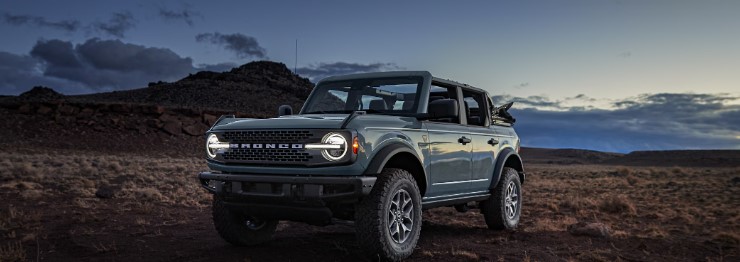
The Ford Bronco Sport and Toyota 4Runner are popular for active, adventure-loving drivers. Each of these capable SUVs boasts that sporty flair that performs just as well in off-road conditions as on a nighttime drive in the city. But which of these SUVs has the edge over competitors? Read as our Bird Kultgen Ford team compares the Ford Bronco Sport and Toyota 4Runner with a point-to-point comparison to help you identify the ideal vehicle for getting around in Waco, Texas.
Ford Bronco Sport vs. Toyota 4Runner: Overview and Exterior
The Ford Bronco Sport is a masterpiece of retro all-terrain styling with more than a nod to its ’60s and ’70s heyday. It has a classic upright stance, signature round headlights, a bold BRONCO grille, and engineering for rugged off-road excursions. The Badlands trim’s front tow hooks and spare tire cover evoke the spirit of adventure. However, the Bronco Sport isn’t left in the past, as its compact dimensions allow easy handling in even the densest urban settings.
The Toyota 4Runner has a rugged and purposeful exterior design with compact proportions, making it an excellent choice for daily driving. It has less character than the Bronco Sport but still turns heads with bold colors, including Ice Cap, Supersonic Red, and Everest. The 4Runner also delivers eye-catching detailing, including a black horizontal bar grille, trim-specific badging, over-fenders, and a bold rear spoiler.
Ford Bronco Sport vs. Toyota 4Runner: Powertrain and Performance
A performance SUV needs power and agility. The Ford Bronco Sport stays versatile with its innovative 1.5-liter three-cylinder engine that produces 181 hp. The Badlands trim features a turbo 2.0-liter four-cylinder engine that provides 250 hp. This rugged four-wheel-drive SUV has an eight-speed transmission. Fuel efficiency for the Bronco remains respectable, with a combined city/highway fuel economy of up to 26 mpg.
The Toyota 4Runner has a turbocharged 2.4-liter four-cylinder engine that produces 278 hp and an eight-speed automatic transmission. The standard trim is rear-wheel drive with an optional all-wheel-drive upgrade. The 4Runner gets a combined 17 mpg.
Ford Bronco Sport vs. Toyota 4Runner: Interior
With the interior, the Bronco Sport leaves its retro ruggedness at the door. You can expect a well-upholstered, easy-to-clean interior featuring full carpeting and durable fabric seating with a six-way manual driver’s seat and a four-way manual passenger seat. Stylish touches include front and rear map lights, the innovative MOLLE strap system, and the safari-style roof. The interior space offers ample room for five passengers and cargo.
The 4Runner offers a spacious but somewhat more conventional interior that draws heavily from the Toyota Tacoma pickup truck. Optional third-row seating with a durable fabric trim provides seating for up to seven with plastic molded armrests and cup holders. The 4Runner offers a near-convertible experience when you drop the side and rear windows and slide open the optional moonroof.
Ford Bronco Sport vs. Toyota 4Runner: Off-Road Capabilities
The Bronco Sport is perfect for off-roading. Its most rugged trims offer up to five G.O.A.T. (Goes Over Any Type of Terrain) modes that deliver specialized driving settings for specific off-road conditions. Its four-wheel-drive system, unique suspension, and available bash plates and front tow hooks ensure you can take it anywhere you want to go.
The 4Runner is also off-road capable. The TRD Pro trim stands out. It features Toyota’s part-time four-wheel-drive system and a stabilizer disconnect mechanism that delivers the extra suspension the vehicle needs to take on the roughest terrain.
Ford Bronco Sport vs. Toyota 4Runner: Safety Features and Technology
Off-road capable vehicles need superior impact protection and safety features so you can handle even the roughest terrain confidently. The Ford Bronco Sport delivers with the Ford Co-Pilot360 suite, which includes the following:
- Blind-spot information system
- Cross-traffic alert
- Pre-collision assist
- Automatic emergency braking
- Adaptive cruise control
In addition, the trail-oriented Bronco Sport trims come with innovative steering, 1-pedal drive, and roll stability control technologies. The Bronco Sport also has a full airbag system with front, overhead, and side airbags.
The Toyota 4Runner benefits from numerous cutting-edge safety technologies with its integrated Toyota Safety Sense 3.0. This safety suite provides a range of driver-assistance technologies, including the following:
- Precollision system with pedestrian detection
- Automatic high beams
- Lane tracing assist
- Dynamic radar cruise control
- Lane departure alert with steering assist
- Road sign assist
Ford Bronco Sport vs. Toyota 4Runner: Infotainment and Connectivity
Advanced, intuitive infotainment enhances the driving experience for both these vehicles. You can expect touch-screen displays, Wi-Fi hotspots, quality audio, and easy Android Auto and Apple CarPlay integration.
The Ford Bronco Sport has a 4.2-inch instrument cluster, an 8-inch LCD touch screen, and the latest SYNC 3 software. It features 4G LTE Wi-Fi connectivity and offers wireless charging and a powerful Bang & Olufsen audio system to entertain you.
The 4Runner has a digital gauge cluster with a 7-inch color multi-information display. There’s an 8-inch touch-screen multimedia display with an integrated eight-speaker audio system. Upper trims offer a larger gauge cluster and touch-screen display. On-board connectivity is subscription-based, but the 4Runner has USB-C ports for charging.
Put the Ford Bronco Sport Through Its Paces at Bird Kultgen Ford
If the Ford Bronco Sport impresses you, why not experience its prowess by scheduling a test-drive at Bird Kultgen Ford? We have an outstanding inventory of new Bronco Sport SUVs, and our friendly sales staff can answer your questions. Get behind the wheel of the Bronco by contacting our Waco dealership online, by phone, or by visiting us in person.
Connect with us


Recent Blog Entries
- 2026 Ford SUV Lineup Breakdown: Which Model Fits Your Life in Waco, TX?
- What Ford Handles Texas Backroads Best? Our Top Picks for Rural Driving in Waco, TX
- Best Restaurants To Celebrate The New Year’s at in Waco, TX
- 2026 Ford F-150 vs. The Competition: How the F-150 Stands Out in the Truck Market
- Local Eats: Top BBQ Joints in Waco You Can Drive to Today